
The Mirasol's Hotel Years
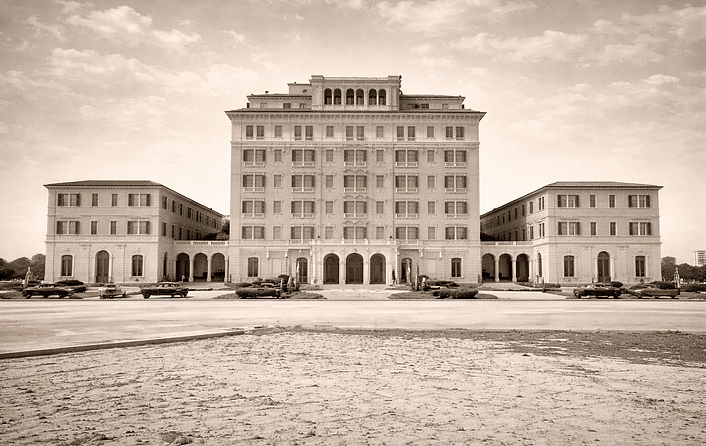

November 1926 – 6 months after grand opening
The Mirasol: A Historical Look at Davis Islands’ 1920s
Apartment-Hotels
The Mirasol is one of the most recognizable historic buildings on Davis Islands — but its real early history is rarely told. Built during the height of Tampa’s 1920s land boom, the Mirasol was the third of three apartment-hotels constructed by developer D.P. Davis (following the Palmerin and the Biscayne). Each of these buildings opened with high expectations and lavish promotion. Each quickly faced severe financial distress. This page traces the early, little-known story of the Mirasol — from its ambitious construction, to its rapid collapse, to its eventual rebirth as the apartment building neighbors know today.

The Boom Years: A Grand Vision (1926)
The Mirasol opened in April 1926 as a $750,000 Mediterranean Revival apartment-hotel, one of the most expensive buildings in Tampa at the time. Like its sister buildings — the Palmerin and the Biscayne — it offered furnished apartments with hotel-style services for long-term winter visitors rather than short-stay tourists. But while the architecture was grand, the setting was not. Davis Islands was still largely undeveloped sand flats with very few residents, limited infrastructure, and a real estate market built almost entirely on speculation. The Mirasol’s hotel concept depended on a level of demand that simply did not exist.
Early Financial Difficulties
Although newspapers celebrated its opening, the Mirasol struggled financially almost immediately. Historical tax records show that the building began accumulating significant unpaid taxes well before 1929, a sign that it was not generating enough income to cover even its basic obligations. With fewer than 100 residents living on Davis Islands until the early 1930s, the customer base for a large apartment-hotel never materialized. Occupancy was low, expenses were high, and the building operated at a loss. In 1929 it closed down for nearly 3-years, before reopening with a different owner.
Ordered into Foreclosure (1930) and Sold at Court Auction (1931)
By 1930, the financial situation had deteriorated so severely that the Mirasol was ordered into foreclosure. It had accumulated substantial delinquent taxes, it was in mortgage foreclosure, and required a court-appointed receiver to manage the property. In 1931, the Mirasol was sold at a public courthouse auction for $15,500 — a staggering drop of more than 98% from its original construction cost. No investor stepped forward to continue hotel operations on Davis Islands, and the building’s revenue could not support its operating or tax burdens.
Expert Testimony: A Hotel Not Suited to Its Location
During litigation that followed the foreclosure through 1935, expert testimony and court record
findings described the Mirasol in unusually candid terms:
-
The building was not well located for a commercial hotel.
-
Its interior layout and design features were poorly suited to profitable hotel operations.
-
The property had been vacant for long stretches.
-
Its income was insufficient even to pay taxes, let alone debt or operating costs.
-
It was considered unlikely ever to produce a fair financial return as a hotel.
The historical record is clear: the Mirasol’s hotel concept was not sustainable in the context of
early Davis Islands.

1946
A Pattern: All Davis Islands Hotels Struggled
The Mirasol’s failure was part of a broader pattern.
The Palmerin and the Biscayne — both built just months earlier — also faced immediate
financial distress and were sold for far below their construction costs in 1928 auctions.
-
The Palmerin, built for roughly $450,000, sold at auction for $125,000.
-
The Biscayne, built for roughly $350,000, sold for $113,000.
Although each of the original D.P. Davis built hotel circumstances varied, the outcome was the
same: Davis Islands’ early apartment-hotels were beautiful buildings constructed in a market that could not support them. All three failed financially within a few years of opening. The boom-era vision of a thriving resort district simply did not match the economic reality.
Continued Difficulties Through the Mid-Century
The Mirasol continued to change owners through the 1930s, 40s, and 50s, experiencing further financial instability and underwent another foreclosure-related distressed transfer in the 1950s. In 1962, the Mirasol sold for $150,000, the highest price it ever achieved during its hotel life. Even then, that amount represented only 20% of its original 1926 construction cost.

Reborn as Apartments (1960s–Present)
After its 1962 sale, the Mirasol entered a new chapter as an apartment residence. This marked the first stable, long-term use the property had ever experienced. For more than sixty years, the Mirasol has functioned as part of the residential neighborhood fabric — consistent with its surroundings, modest in intensity, and compatible with Davis Islands’ character. A separate section of this website will explore the Mirasol’s apartment era in greater detail.
This chart highlights the Mirasols declining dollar value during its hotel years.

A Historical Comparison Worth Noting.
Although this page focuses on history rather than modern redevelopment proposals, one fact provides useful perspective: The proposed redevelopment would increase the Mirasol’s original 1926 building footprint by 2.74×. This scale of expansion — nearly tripling the building’s original footprint — bears no resemblance to the Mirasol’s historical size, use, or presence on Davis Islands that D.P. Davis once envisioned.
For more information on the PD rezoning, visit this page.